

Planting Tansy or Costmary in Your Backyard: Rules and Cossack Secrets
Before you get ready to plant tansy or its closest relative, costmary, at home, I suggest you familiarize yourself with the characteristics of these medicinal plants, their propagation methods, and the right location and soil for planting. These crops will not only beautify your garden but will also become your living home pharmacy.
Зміст
Where and How to Plant Tansy and Costmary (Kanupher)
Common tansy is a widespread and exceptionally resilient plant. In the wild, it can be found along riverbanks, in forest glades and clearings, in brushwood, along roadsides, and in meadows. Interestingly, tansy significantly prefers dry, sunny spots over areas directly near water.
The plant can reach a height of up to 4.5 feet (1.5 meters). Its leaves are broad, deep green, almost hairless, and densely cover the sturdy stems. The bright yellow flowers are gathered in compact, flat-topped flower heads that look like little buttons from a distance. The blooming period lasts from June to September. Tansy belongs to the Asteraceae (daisy) family.
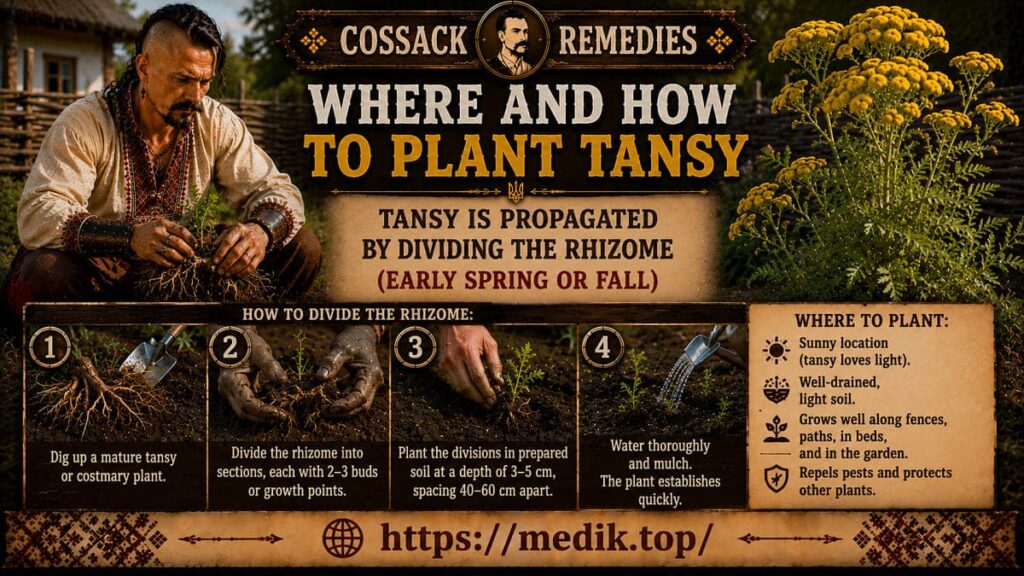
This crop is completely unpretentious when it comes to growing conditions. You can successfully plant tansy in almost any type of soil. The only thing the plant absolutely cannot tolerate is permanently waterlogged, acidic, or highly saline areas. It propagates best by dividing the rhizome (in early spring or autumn). Despite its general drought tolerance, tansy responds very well to regular, moderate watering, which makes it look much lusher.
Harvesting raw materials. The time to harvest comes at the very beginning of the blooming period. You should cut the upper part of the shoot, about 14–16 inches (35–40 cm) long, along with the flower heads. Dry it in the shade. In folk medicine, it is this herb with flowers that is used, and it can retain its beneficial properties for 2–3 years.
Costmary (Kanupher) — The Forgotten Cossack Plant
If you plan to plant costmary (locally known as kanupher or balsam herb), you should know that its planting requirements are completely identical to those of tansy. They are close relatives. However, costmary has its own unique, unmistakable balsamic aroma with distinct notes of mint and cinnamon.
During the era of the Ukrainian Cossacks, costmary grew next to every house and in monastery gardens. It was revered not only as a medicine but also as a unique savory spice. Our ancestors used the aromatic leaves of the kanupher plant to flavor home-brewed beer, kvass, various sweet dishes, and also added them to fish and meat recipes. Dried costmary leaves were once placed in books as bookmarks; they not only provided a pleasant scent but also repelled insect pests like book moths.
The Use of Tansy and Costmary in Folk Medicine
Common tansy. The inflorescences of the plant possess the greatest therapeutic effect. They are rich in camphor, tannins, alkaloids, lactones, flavonoids, and valuable essential oils.
Thanks to this composition, tansy possesses the following properties:
- choleretic (bile-stimulating) and anti-inflammatory;
- antispasmodic and analgesic (pain-relieving);
- astringent and antimicrobial;
- antipyretic (fever-reducing) and a powerful anti-parasitic action.
In addition, remedies made from tansy can slightly increase blood pressure and boost the amplitude of heart contractions.
What Problems Does Tansy Infusion Help With?
- Gastrointestinal tract: gastritis with low acidity, colitis, anacid disorders, and impaired stomach secretion.
- Body detox: high efficacy against intestinal worms (roundworms, pinworms) and lice.
- Nervous system: headaches, neuroses, epilepsy, and general nervous exhaustion (acts as a mild sedative).
- Joints and metabolism: rheumatism, gout, and polyarthritis.
- Urinary system: inflammation of the kidneys and urinary bladder, as well as the early stages of kidney stone disease.
- External application: washing purulent wounds, ulcers, boils, tumors, treating scabies, and relieving muscle spasms.
Infusion Recipe: Pour one cup of cold water over 1 teaspoon of chopped, dried raw material. Let it infuse for 3–4 hours, then strain it. Take 1 tablespoon 4–5 times a day. As an anti-parasitic remedy (as directed by a specialist), adults drink one cup of the infusion in a single dose, and children take half a cup.
⚠️ Warning — the plant is toxic! Due to its thujone content, tansy requires strict dosage. It is undesirable to treat children, pregnant women, and breastfeeding mothers with this infusion unless absolutely necessary. Any internal use must be carried out under professional guidance.
📜 Conversation with a Kharakternyk: Answers to Frequently Asked Questions
And now, a Cossack Kharakternyk (warrior-mystic) answers the most common questions about these healing herbs. If you haven’t found the answer to your question, feel free to ask in the comments below this post, and you will definitely get a piece of advice from the Kharakternyk!
Can I plant tansy near my vegetable garden to protect it from pests?
Yes, it is an excellent natural insecticide. Thanks to its sharp camphor smell and specific essential oils, tansy planted around the perimeter of a garden repels Colorado potato beetles, aphids, onion flies, and ticks. An infusion made from the flowers is also frequently used to spray fruit trees.
How does costmary differ from common tansy?
Although they belong to the same genus, common tansy has deeply dissected leaves (resembling mountain ash) and smells sharp and bitter-camphorous. Costmary (kanupher) has whole, oblong, silvery-green leaves with fine teeth, and its aroma is soft and pleasant, with a pronounced balsamic-minty undertone. Costmary is more commonly used specifically as a culinary spice.
When is the best time to divide and transplant costmary and tansy?
The best time to divide a bush and plant it in a new location is either early spring (April, before active growth begins) or mid-autumn (October). They have creeping, sturdy rhizomes, so they take root surprisingly easily and spread rapidly.
Now you know all the intricacies of why it is worth it to plant tansy or costmary in your backyard. These plants will not only help heal you but will also reliably protect your garden from uninvited guests.
Stay healthy! Sincerely, Medik.Top.