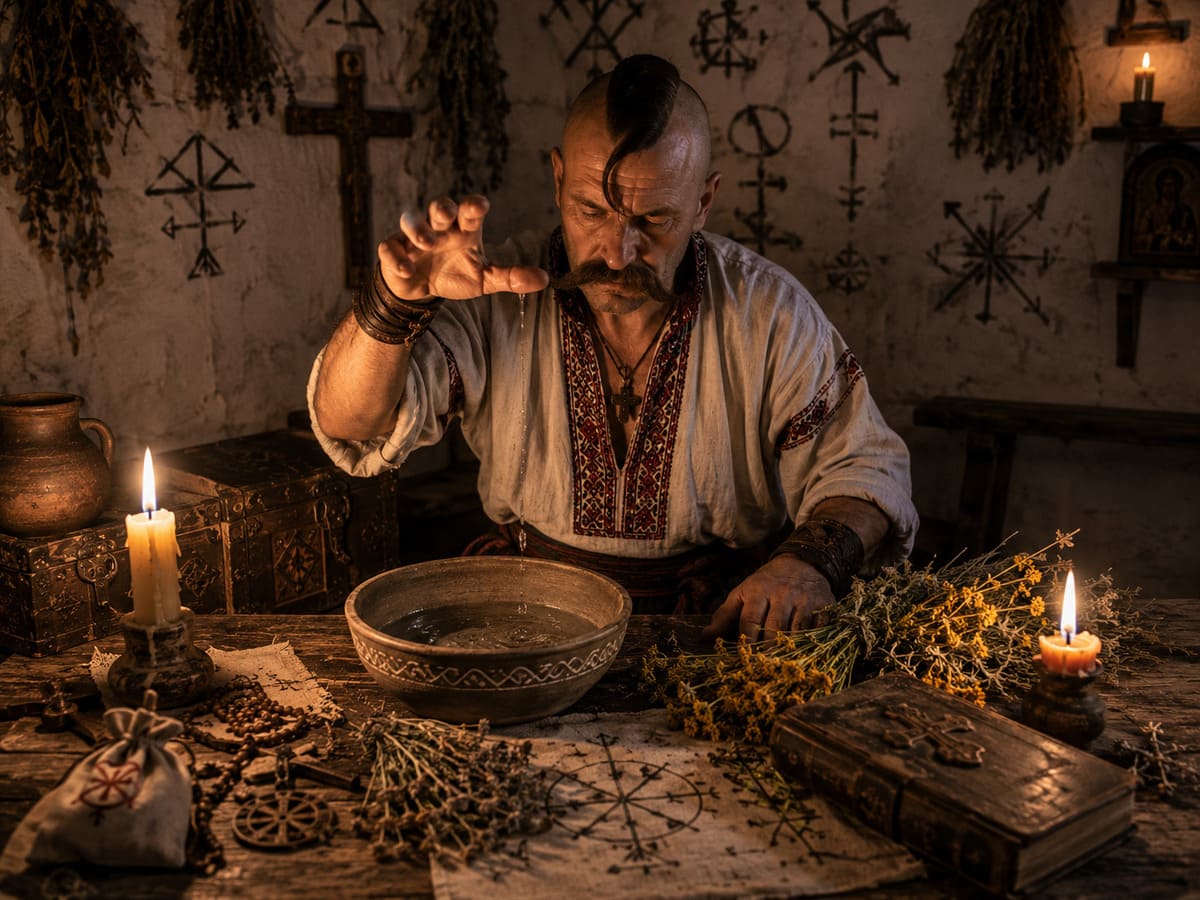
Within the world of Slavic Folk Magic & Spirit, there exists a group of healers unlike any other — the znakhars, direct descendants of the Cossack charakternyky. These are men and women who learned to move between the visible and invisible worlds, to influence the hidden forces of nature, to cure what ordinary medicine cannot name and to protect what ordinary people cannot see. Their knowledge commands equal measures of reverence and fear. To cross a znakhar was considered unwise. To earn their help was considered a blessing.

Explore Slavic Folk Magic & Spirit — ancient znakhar traditions, Cossack rituals and mysterious healing knowledge passed down through generations.

The Mysterious Knowledge of Ukrainian Healers

In Ukraine, the znakhar has always occupied a unique place in the community. Feared, yes — but never dismissed. On Polissia, the local healer held the first voice at community gatherings. In the Hutsul highlands, they were called mudri — the wise ones — or zemlyani bohy, the earth gods. In the Boyko region, they were simply called bohy — gods — or neprosti lyudy, the uncommon people. In central Ukraine, the term znatnyk — the one who knows — was most common.

Many believed that a znakhar was born under a particular star, marked from birth with knowledge that ordinary people could never access. Others held that anyone born on a Monday — and weaned from their mother’s breast on a Monday — carried healing power within them. The youngest child in a family, called mizyn, was said to be able to cure warts and boils with a single touch of their little finger. The firstborn, called pervísnyk, was believed to see misfortune coming before it arrived — and to recognize evil spirits that remained invisible to everyone else.

Can the Ancient Knowledge Be Passed On?

This is one of the most fascinating questions within Slavic Folk Magic & Spirit — and the answer, according to tradition, is yes. But only under very specific conditions.

The knowledge could only be transmitted to someone younger than the teacher — never to someone older. In the Hutsul tradition, the sacred chants and incantations known as bay could only be learned on a great holy day. In Chernihiv region, the rule was precise: the craft had to be received on the third attempt. “If you cannot remember it by the third time, you will never be able to help others.”

Other traditions held that the knowledge passed through objects. A dying znakhar might offer:

  1. A cup of water over which he had whispered his final incantations
  2. A glass of horilka from his own hand
  3. A broom he had held in his last moments
  4. Or the fulfillment of his dying wish

This is why people were careful never to accept anything from the hands of a dying healer unless they were prepared to inherit everything that came with it — the gift, the burden, and the responsibility.

The Specializations of the Znakhar

Like physicians in any tradition, healers within Slavic Folk Magic & Spirit were not generalists. Each znakhar developed their particular area of mastery:

  1. Some specialized in curing rozha — a skin inflammation known in the West as erysipelas
  2. Others focused on lifting vroky — the evil eye and its effects
  3. Still others extracted perelyak — the condition of deep fright that could settle into the body and cause lasting illness
  4. Some were known for charming away toothache or stopping the flow of blood
  5. Others healed snakebite
  6. And some treated internal conditions that no herb alone could reach

Their methods combined spoken magic — incantations, whispered prayers, ritual formulas — with practical remedies, plant-based medicines, and even surgical techniques passed down through generations.

The Rules of the Healing Ritual

A znakhar did not simply speak their incantations whenever and wherever they wished. The practice was governed by precise rules that connected the healer to the rhythms of nature and the sacred calendar:

  1. Always perform the ritual on an empty stomach
  2. Always before sunrise
  3. On the threshold — neither fully inside nor outside
  4. In the open air or an open field
  5. Over flowing or standing water
  6. Beneath an aspen tree or a viburnum
  7. Facing east — always east

In the Hutsul highlands, it was forbidden to whisper incantations on holy days. In many regions, healing could only be performed on specific days of the week — Wednesday and Friday being the most powerful. And perhaps most importantly of all: the znakhar’s ability to inspire belief in the patient was considered as essential as any remedy. Without faith in the healer, even the strongest medicine could fail.

This is the world of Slavic Folk Magic & Spirit — ancient, layered, and very much alive for those willing to look.