
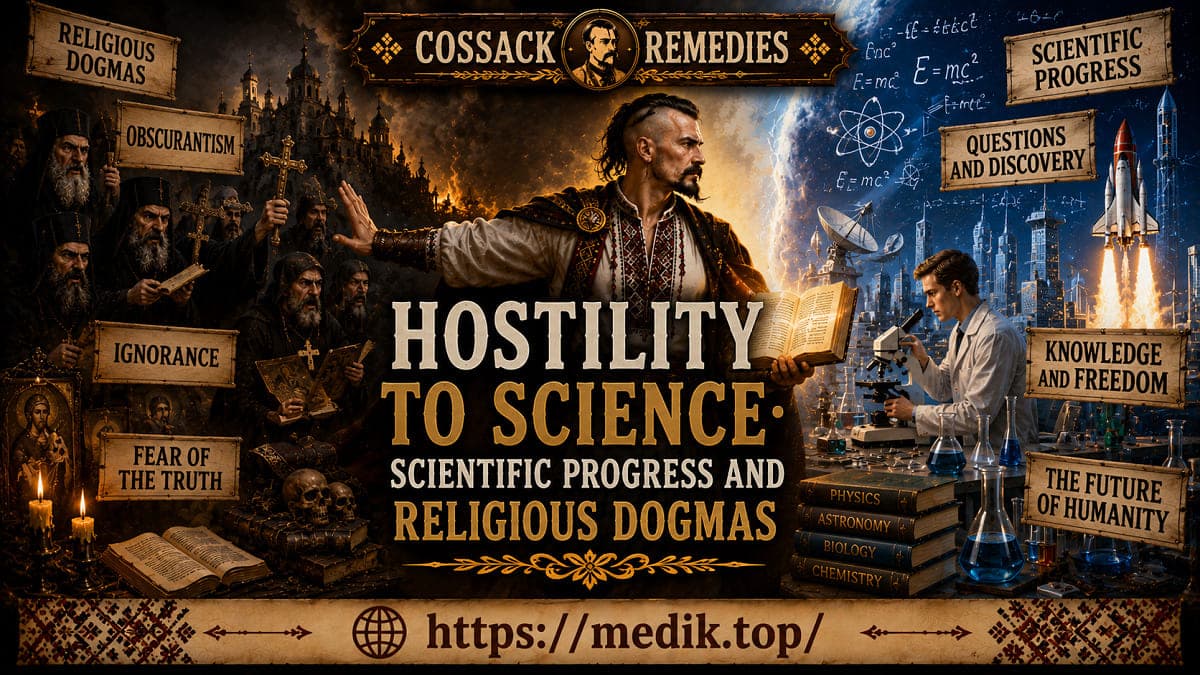
Hostility to Science: Scientific Progress and Religious Dogmas
Somewhat later, with the arrival of the Scientific and Technological Revolution, the emergence of obscurantism became a prominent organizational movement. In other words, it became a social practice that openly manifested hostility toward science.
The core ideas of obscurantism can be summarized as follows:
- Obstructing any reformist actions within society.
- Believing that enlightenment is harmful to the masses.
- Claiming that scientific and technological progress inherently destroys the environment.
- Insisting that science and culture must remain under the strict control of reactionary forces.
- Completely rejecting dissent and harboring a negative attitude toward people who practice different cultures or faiths.
Historically, this entire list of ideas was used to block religious reforms and protect rigid religious dogmas. In the 20th century, however, this mindset largely lost its overtly religious direction.
Зміст
“Science is Bad”
No, really, think about it! Scientists are constantly inventing things, but do they have even the slightest clue what they are actually doing? They have developed a mad desire to control nature—a so-called “thirst for knowledge”—that is ready to destroy absolutely everything just so science can prosper.
Take a scientist who creates some sort of mechanism. It is born out of agonizing labor, it gets launched, and… bam, it doesn’t work! What is that about? Well, as stated above, it’s clear they have no idea what they are creating. Maybe it was supposed to be a time machine, a rocket to launch a satellite, a TV tower, or just a piece of junk, but in the scientific world, it holds great significance. The main point here is that the scientist dared to play with forces that belong to God alone, and thus suffered a just punishment.
Hm, yet science keeps developing and being applied, and the environment hasn’t collapsed completely! So, maybe nothing terrible is happening, and this hostility to science is pointless. But scientists might come up with something even worse. They are constantly trying to achieve things without any foresight into the ultimate consequences:
- They will automate everything.
- They will create something potentially cataclysmic.
- They will bring genetic engineering and cybernetics to their absolute limit.
- They will drive humanity to immortality.
- They will synthesize new forms of life.
- They will try to resurrect the dead.
- They will attempt to usurp the throne of God.
Oh right, let’s not forget about the creation of Artificial Intelligence. They thought of that too! What if it breaks free, reduces its creators to ashes, and enslaves everyone else on the planet? After all, AI lacks anything living; wiping out all life on Earth would be a piece of cake for it.
🤖 But the scariest part might be the creation of an artificial intelligence that is capable of destroying humanity through artificial means, turning people into robots and obedient mechanisms.
Some might say this is pure science fiction. But take a moment to look out your window and see how nature is dying. Rare wildlife is vanishing, and total deforestation is underway. Who is to blame? You can safely attribute all of this to scientific civilization—there is simply no one else.
People and Their Hostility to Science
“The scientific world already knows so much!”
You don’t need a fortune teller to figure this one out: science knows that it doesn’t know a lot, which is why it puts so much effort into discovering more. It’s a completely different story when it comes to divine pamphlets or the “all-knowing” neighborhood gossip, whose peak of knowledge consists of wild fantasies straight out of the Stone Age.
“All this chemistry and radiation only bring harm!”
Anyone reaching this conclusion should get rid of their car immediately, since it runs on chemical gasoline and is “shod” in chemical tires. While they’re at it, they should throw away their cell phone with its chemical plastic body—not to mention its sin of emitting electromagnetic radiation. Their food rations should be cut down drastically too, because mineral fertilizers are pure chemistry.
And what about dental fillings? They contain chemical photopolymers, so those need to go right away. Besides, if we reason at a primitive level, as mentioned earlier, nobody used fillings back then, and people supposedly lived to be a hundred in perfect health.
Some of these “smart alecks” are genuinely exhausting. Who is forcing them to live in cities packed with chemistry, far from the pristine natural environment? They can easily pack their bags, settle in a shack somewhere deep in the woods, grow turnips, and breathe in the pure scents of nature.
The End of Science?
There have always been plenty of skeptics who believed that science, by definition, has absolute limits and is therefore unable to grasp everything happening in reality. As it turns out, this judgment is false. No scientific inquiry has ever encountered an insurmountable boundary—well, except for certain limitations in quantum mechanics.
Yet, some claim boundaries exist, pointing to historical examples: vitalists believed that physics and chemistry could never fully describe the phenomenon of life. This belief persisted right up until it became clear that the “problem of life” didn’t actually exist in that sense. Furthermore, molecular biology eventually transformed into the primary tool for studying living phenomena.
According to certain individuals, human consciousness will never succumb to a scientific description. This is where their hostility to science partly manifests. The sources of this argument lie in the traditional separation of the physical body and the spiritual soul, viewing the soul as something existing entirely outside the material realm.
However, it turned out that physics and cybernetics actually hold the crown when it comes to understanding a phenomenon like consciousness.
The Roots of Hostile Attitudes Toward Science
Hostility to science typically arises from two scenarios:
- The result of a logical, but not always correct, conclusion that scientific discoveries or the methods used by science run counter to values of great importance to a person.
- Illogical elements rooted in an emotional incompatibility between the mindset embodied in scientific understanding and the feelings nurtured by other social institutions. Whenever the validity of this feeling is questioned, it undergoes rationalization.
These conditions form the foundation of the modern rejection of science. Nevertheless, approved goals are still achieved through scientific means. In such cases, core cultural values align with scientific values, bypassing emotional conflict. It follows that scientific activity in the modern world is the result of an interaction between two opposing forces: one that approves of the scientific approach, and another that resists it.
Obscurantism: Hostility to Science, Education, and Progress
Today, obscurantism stands as the primary danger manifesting hostility toward science and threatening humanity. It brings spiritual and intellectual degradation, division, and totalitarianism, ultimately leading to the erosion of the human personality.
👺 The concept of obscurantism encompasses all those phenomena that obstruct humanity’s forward momentum toward freedom, happiness, and prosperity driven by knowledge and progress.
It becomes entirely obvious that obscurantism goes hand in hand with the cynical exploitation of people for greedy purposes—brainwashing and deceiving them while imposing false views, perceptions, and behaviors.
Obscurantists are easily recognized by their actions. Their goal is to eliminate free-thinking individuals as a concept, replacing them with submissive, voiceless zombies.
To bring their sinister plans to life, modern obscurantists put immense effort into sowing discord within human communities, pitting people against one another to divide and conquer.
The Friendship and Feud of Religion and Science
How are religious dogmas perceived in the scientific community? And how does religion evaluate scientific activity? Can they exist without one another?
Throughout history, humanity has attempted to engage in scientific activity while bypassing religious beliefs, just as it has used religious arguments to manifest hostility to science. The largest wave of people abandoning religious beliefs occurred in the 19th and 20th centuries, driven by positive catalysts like Darwin’s theory and scientific atheism. This was a deliberate attempt to rid the public sphere of religion.
However, there were numerous instances where devout believers rejected science entirely, and scientists faced severe persecution. This was a highly popular phenomenon in medieval Europe. Even today, pockets of resistance to scientific activity remain across the globe. But the most interesting irony is that while scientists were burned at the stake in medieval Europe, those same regions have now evolved into the most developed nations on the planet.
Science and Religion: Enemies or Allies?
Proponents and representatives of the scientific community still express the view that religious and scientific worldviews are fundamentally incompatible. However, these arguments rest on shaky ground.
In truth, the idea that religion is inherently hostile to science is one of our most persistent prejudices. The root of the issue is that scientific inquiry does not provide the answers the human mind craves: what is the universe made of, and what is the meaning of human life within it?
👨🏻💻 Science studies the visible, material part of the environment along with its phenomena. It leaves out only one factor—the existence of another real world, one that is invisible and spiritual.
😇 Religion, on the other hand, seeks to know God and the spiritual realm with its inherent laws, which in turn leads to an understanding of the material world, but in an inseparable bond with the spiritual.
Can We End the Feud Between Science and Religion?
A new British project aims to reconcile religion with science. Regardless of the obstacles, it will bring together seminarians and Christian scientists to study contemporary scientific topics. In doing so, it hopes to lower the temperature of hostility toward science.
Future priests and other project participants will gain access to the resources of modern knowledge. The program also includes examining how church hierarchies view scientific endeavors.
Today’s scientific community holds diverse views on faith. While some scientists adopt strictly atheistic positions, others take a more open approach; there is no single consensus. Nevertheless, this attempt at reconciliation has found a positive resonance in society.
Hostility to Science in Psychology
Hostile behavior has a wide variety of expressions, and the concept of hostility itself receives ambiguous and contradictory interpretations.
From the earliest stages of psychoanalytic research, hostility to science was grouped together with concepts of aggression, anger, and cynicism, lacking a clear differentiation. Early attempts to define it revealed numerous behavioral and emotional correlates of animosity. Today, it is viewed as a cognitive component of the psyche—a complex structure functioning in tandem with anger and aggression.
In some cases, it is treated as an individual trait or a personality characteristic. In others, it is viewed through the lens of interpersonal relationships, which includes the beliefs, biases, and evaluations applied to other people.